


Uncategorised
Workshop Desk or Workbench? Signs Your Home Setup Has Outgrown a Desk
Jul
Your garage project started with a simple laptop or a craft knife, but lately, the table you are using is fighting back. Maybe you noticed the wood top bowing under the weight of a motor or a drill press. Or perhaps you spend more time cleaning sawdust off your computer keyboard than actually building anything. There is a distinct line between a hobby that lives on a workshop desk and a serious craft that demands a real industrial foundation. Staying on a standard desk once you start doing heavy-duty work creates frustration. It kills your speed. It hurts your back.
Recognizing the transition point is the first step toward building a better shop. This blog breaks down the physical, safety, and workflow indicators that signal it is time to move up from office furniture to a proper workspace.
The Stability Threshold
Office desks have one job: hold a computer and a cup of coffee. They are engineered for stability at a very low weight threshold. When you put a heavy-duty vice or a bench grinder on that setup, you are asking for trouble. The vibration alone will travel through the entire structure, turning every screw and joint into a loose rattle within weeks.
Real industrial equipment requires a frame that doesn’t just hold weight but absorbs force. If your current surface moves even a few millimeters when you apply pressure with a hand tool, you are losing energy. That energy loss translates to poor-quality cuts, messy soldering, or imprecise assembly. A true workbench is built to handle downward force, side impacts, and high-torque tasks without swaying.
Space Efficiency vs. Clutter
Working on a small desk forces a workflow that is usually interrupted by constant clearing. You finish one step, move the parts, clean the surface, then start the next step. A professional setup gives you the square footage to spread out. It allows you to keep your primary tools mounted or within arm’s reach while leaving a clear area for the active project.
Signs You Need More Than a Desk:
- Tools regularly slide off the edge because the surface is too cramped.
- You keep your heavier power tools on the floor instead of on the table.
- The legs of your desk are starting to splay outward from the weight.
- There is no room for secondary equipment like a drill press or belt sander.
- Oil or chemical spills permanently stain the desk material because it isn’t industrial grade.
Material Durability and Maintenance
Standard desks are usually made of particleboard with a thin laminate. One slip of a chisel or a hot soldering iron leaves a permanent scar. In a real shop, the surface is a tool itself. Professional-grade workbenches utilise materials like thick steel plate, solid hardwood, or industrial-grade laminate that can handle impact.
If you are sanding wood or cutting metal, the dust and debris will get everywhere. An office desk has corners and crevices that are nearly impossible to clean. Industrial benches are designed with accessibility in mind. They often have open frames or reinforced supports that make sweeping under or around them actually possible.
Safety and Ergonomics
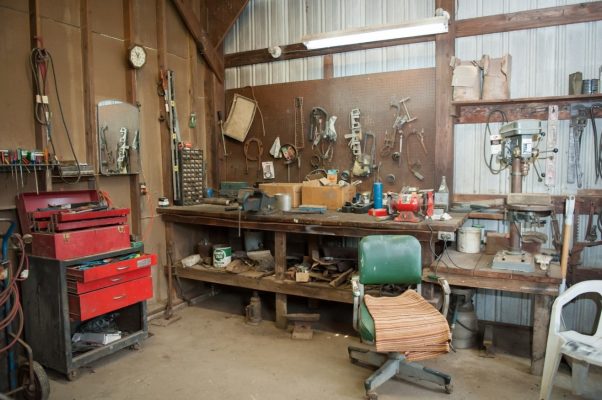
Safety is the most overlooked factor in home shops. A wobbly table is a safety hazard. If a clamp slips or a drill bit binds, a stable, heavy bench absorbs that energy. A light desk will slide or tip. Think about your stance, too. Most desks are set at a height for sitting, but fabrication work is often better done while standing. Standing at a low desk leads to back strain within minutes.
Ergonomic Upgrades to Look For:
- Height-adjustable legs that match your elbow height.
- Enough leg room to sit comfortably if needed for detail work.
- Integrated power points that keep cables away from your feet.
- Ability to mount a heavy-duty vice without cracking the tabletop.
- Rounded or reinforced edges that won’t bite into your forearms during long sessions.
Integrating Proper Storage
You know you have outgrown a desk when your tools are stored in boxes on the floor. A desk provides no vertical storage. A proper workshop workbench is designed to work with you. It uses the space above and below to house your most important gear. Pegboards, overhead lighting, and underslung drawers keep the surface clear. When you don’t have to hunt for a screwdriver, you stay in the flow state. This is what separates a cluttered garage corner from an efficient, productive shop.
The Shift Toward Precision
Moving to a dedicated bench changes your mindset. When you stop worrying about whether your surface will collapse, you can focus on the job. You stop improvising with clamps and start using dedicated jigs. You stop cleaning for twenty minutes between tasks. You begin to treat the space with the seriousness the work deserves. Getting the foundation right is the difference between a project that feels like a chore and one that feels like a professional endeavour.
The Hidden Costs of Constant Replacement
Flimsy surfaces have a way of draining your budget over time. Every time a desk leg snaps or a laminate top bubble from a spill, you have to spend money and effort on a replacement. It is a cycle of small, frustrating investments that never actually get you a solid workspace. A real workbench is built to be a one-time purchase. When you factor in the years of reliable service and the lack of repairs, the price gap between an office desk and industrial furniture disappears. You are buying structural integrity that keeps your projects moving instead of stalling them.
Managing Vibration and Noise
Sound levels in a shop tell you a lot about your setup. If you are working on a hollow desk, every strike of a hammer or hum of a sander acts like an amplifier. The vibration travels through the frame and causes the entire surface to resonate. This noise is more than just a nuisance. It is a sign that your energy is being wasted as sound rather than being applied to your material. A solid industrial frame dampens this vibration, keeping the shop quieter and your tools functioning at their peak without the constant chatter of a loose structure.
Conclusion
Investing in a high-quality station is about long-term productivity. When you buy equipment that matches the intensity of your work, you stop replacing cheap parts and start building things that last. If you are looking to upgrade from a temporary setup to something that can anchor your shop for decades, Workshop Workbench offers the modularity and heavy-duty engineering to make that jump worthwhile.
Frequently Asked Questions
Is a wooden workbench better than a metal one?
It depends on the project. Wood is excellent for woodworking as it is easier on cutting tools, while steel is essential for metal fabrication, welding, and tasks involving heat or heavy chemicals.
Can I use a kitchen table as a temporary workbench?
You can, but it is not recommended for heavy work. Kitchen tables lack the structural rigidity to handle high impact or vibrations, and you risk ruining the surface with scratches, heat, or spills.
How high should my workbench be?
A good rule of thumb is to have the top of the bench reach your hip height or slightly higher. For precision work, it should be higher, while heavy-duty work is easier at a lower height to allow you to put your weight behind the tool.
What is the best way to anchor a workbench?
If your bench is heavy, its own weight is often enough. For lighter setups, you can use floor bolts or wall brackets to secure the frame, ensuring it stays rock steady during heavy grinding or hammering.