


Uncategorised
Workbench Accessories Every UK Workshop Should Have: Lighting, Storage and Power

Jun
A tidy bench with no accessories is just a table. Walk into any serious workshop, and you will notice straight away that the bench itself is only part of the setup. What surrounds it, sits above it, and plugs into it is what makes it actually functional.
Most people buying a workbench UK focus heavily on the bench itself. Load capacity, frame material, worktop type. All important. But accessories are what transform a bench from a flat surface into a proper working environment. This article covers the three areas that matter most: lighting, storage, and power.
Why Accessories Matter More Than People Realise
Poor lighting causes mistakes. Cluttered surfaces slow work down. Reaching for a power source three metres away on a live task is both inefficient and genuinely risky in some settings.
None of this is dramatic. It is just what happens when a workspace is under-equipped. The good news is that the right accessories are not complicated. They just need to be chosen deliberately rather than added randomly over time.
Lighting: The Most Underestimated Workshop Accessory
Bad lighting in a workshop is not just uncomfortable. It leads to errors. Fine measurements get misread. Joints get cut slightly off. Small components get missed entirely.
Overhead LED lighting mounted directly above the work surface solves this cleanly. Unlike a ceiling light that has to illuminate an entire room, a bench-mounted LED unit directs light exactly where it is needed. Modern LED strips deliver bright, consistent output without generating the heat that older fluorescent fittings produced. That matters in workshops where flammable materials are present.
For detail work, particularly in electronics assembly or precision fitting, the angle of light matters as much as the brightness. A fixed overhead strip works well as a base layer. A secondary articulated lamp for close work is worth having alongside it, especially when inspecting small parts or working with fine tolerances.
One thing that often gets overlooked is colour temperature. A warm light feels comfortable but makes it harder to distinguish certain colours accurately. A cooler, daylight-balanced LED is generally more practical for technical workshop tasks.
Storage: Keeping the Surface Clear Without Hiding Everything
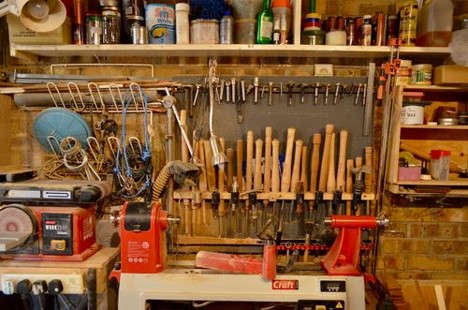
A cluttered bench surface is a slow bench. Tools left out from a previous job, consumables stacked wherever there was space, documentation piled at one end. It all adds up. And every few minutes spent hunting for something is time and focus lost.
The best storage setup for a workshop workbench is one that keeps frequently used items within arm’s reach without piling them on the work surface itself. That means thinking vertically as much as horizontally.
Upper shelving mounted above the bench is one of the most practical additions available. It takes items off the surface entirely while keeping them visible and accessible. Louvre panels and tool boards serve a similar purpose for hand tools. Everything has a designated spot, and gaps in the layout make it immediately obvious when something has been put down somewhere it should not be.
Here is what a well-organised bench storage system typically includes:
- Upper shelf for equipment, documentation, or supplies used regularly but not constantly
- Louvre panel or pegboard for hand tools, keeping them visible and within reach
- Under-bench drawers or cupboards for bulkier items and less frequently used stock
Getting this right from the start is much easier than retrofitting storage after the fact.
Power and Connectivity: Built In, Not Bolted On

Extension leads trailing across a floor or draped over a bench edge are a trip hazard and an organisational nightmare. Integrated electrical sockets built into the bench structure solve this properly.
For work benches UK used in electronics, testing, or any task requiring powered tools or equipment, having sockets positioned at bench height removes a constant friction point. No reaching down to floor-level sockets. No cables crossing the work surface unnecessarily.
Ethernet ports are increasingly relevant too. Workshops running computerised equipment, networked testing tools, or even just a bench PC benefit from a wired connection rather than relying on Wi-Fi that may be inconsistent in a metal-heavy environment. Having it built into the bench from the start is cleaner than adding it later.
Monitor arms are worth mentioning here as well. Mounting a screen on an adjustable arm frees up a significant amount of bench surface and positions the display at a proper ergonomic height, which matters on long shifts.
Conclusion
The right accessories turn a good bench into a genuinely productive workspace. Proper lighting reduces errors. Structured storage keeps the surface clear and the workflow moving. Integrated power removes unnecessary friction from every task that needs it.
At Workshop Workbench, all of these accessories are available as part of a configurable setup, so the bench works exactly the way the job demands from day one.
FAQs
What lighting is best for a workshop workbench?
Overhead LED lighting mounted directly above the bench gives the most consistent, glare-free illumination for workshop tasks. A cooler colour temperature is generally more practical for technical work than warm-toned bulbs.
How much storage does a workshop bench actually need?
That depends on the volume and variety of tools used regularly. As a starting point, a combination of upper shelving, a tool panel, and at least one under-bench drawer unit covers most workshop requirements without overcomplicating the setup.
Are built-in electrical sockets worth specifying on a workbench?
For any bench used with powered tools or electronic equipment, yes. Integrated sockets at bench height remove the need for trailing extension leads, which improves both safety and organisation considerably.
Can accessories be added to an existing workbench later?
Many accessories including shelving, louvre panels, and lighting can be added retrospectively if the bench frame is designed to accept them. It is always worth checking compatibility with the original manufacturer before purchasing accessories separately.